The Ultimate Guide to ETFs
Welcome back to myfireinvesting!
If you’ve read our previous guides, you know that we are big fans of simplicity. We don’t like staring at six computer monitors, we don’t like stress, and we don’t like gambling with our future. But this raises a big question: If I’m not supposed to pick individual winning stocks like Amazon or Tesla, what am I supposed to buy?
The answer is three little letters that have created more millionaires than almost any other financial invention in history: E.T.F (Exchange Traded Funds)
In this guide, we are going to break down exactly what an ETF is, why it is the “secret weapon” of the FIRE movement, and look at some numbers to see how they build wealth.
The Problem with Picking Stocks
To understand why ETFs are so great, you first have to understand the nightmare of picking individual stocks. Imagine you are at a grocery store. You want to bake an apple pie. You see a bin of 500 apples.
- Some of them are perfect and delicious (Winning Companies).
- Some look good on the outside but are rotten on the inside (Companies with hidden debt/fraud).
- Some are just okay.
If you pick just one apple, you are taking a huge risk. If that apple is rotten, your pie is ruined. You lose your money.
Wall Street professionals spend 80 hours a week trying to pick the perfect apple. And guess what? Most of them fail. Data consistently shows that over a 15-year period, nearly 90% of professional fund managers fail to beat the market average. If the pros can’t pick the winning needle in the haystack, what chance do we have?
John Bogle, the founder of Vanguard, had a brilliant solution:
“Don’t look for the needle in the haystack. Just buy the haystack!”
What is an ETF? (The “Fruit Basket” Analogy)

Photo by Pelle Martin on Unsplash
ETF stands for Exchange Traded Fund.
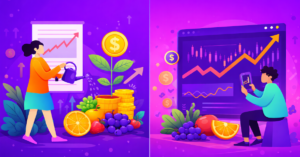
Let’s go back to the grocery store. Instead of trying to pick the single best apple, imagine you could buy a pre-packaged Fruit Basket.
- This basket contains tiny slices of every single apple in the store.
- It also has slices of bananas, oranges, and grapes.
- Because you own a tiny piece of everything, it doesn’t matter if one or two apples are rotten. The good apples will outweigh the bad ones.
That is an ETF. When you buy one share of an ETF, you are actually buying a tiny slice of hundreds or thousands of different companies at once.
The “Exchange Traded” just means they trade exactly like normal stocks. You can buy one share of an ETF on your phone app (like Robinhood, Pearler, Vanguard, or CommSec) instantly during market hours, just like you would buy a share of Apple or Google. It is called a “Fund” because it is a pool of money from millions of investors, managed by a company (like Vanguard, BlackRock, or BetaShares) that does the buying for you.
Why ETFs are the “FIRE” Weapon of Choice
Why is this specific tool the backbone of the Financial Independence movement?
- Instant Diversification (Safety): If you put all your money into one company and that company goes bankrupt (think Enron or Lehman Brothers), you lose everything. If you put your money into an ETF that holds 500 companies and one goes bankrupt, you might lose 0.2% of your money. You probably won’t even notice. Diversification is the only “free lunch” in finance.
- Extremely Low Fees: This is critical. In the old days, you had to pay a manager 2% of your money every year to pick stocks for you. Most passive ETFs are run by computer algorithms that simply track a list of companies. Because it’s automated, the fees are tiny—often 0.03% to 0.10%.
- Active Fund Fee (2%): On a $100k portfolio, you lose $2,000/year.
- ETF Fee (0.05%): On a $100k portfolio, you pay just $50/year. Over 30 years, that difference buys you a house.
- Self-Cleansing Mechanism: This is the coolest part of ETFs that track an index (like the top 500 companies). It is “survival of the fittest.”
- If a company starts doing poorly and loses value, it automatically becomes a smaller part of the ETF.
- If a company eventually fails, it gets kicked out of the index and replaced by a new, growing company. You automatically own the winners and shed the losers without lifting a finger.
A Tale of Two Markets (Real World Examples)
Let’s look at how this actually works in practice. We will look at the two most popular markets for our readers: The USA and our home turf – Australia.
(Disclaimer: The following examples use historical data. Please remember that past performance is not an indication of future performance. Markets move in cycles, and returns are never guaranteed.)
Case Study A: The USA Powerhouse (The S&P 500)
The most famous index in the world is the S&P 500. This tracks the 500 largest publicly traded companies in America. We are talking Apple, Microsoft, Amazon, Google, Tesla, Berkshire Hathaway, etc.
There are many ETFs that track this, but two famous ones are VOO (Vanguard S&P 500 ETF) or IVV(iShares Core S&P 500 ETF). Let’s rewind the clock. Imagine it is January 1, 2013. You have $10,000. You buy an S&P 500 ETF. You do not add any more money. You just sit on your hands for 10 years.
- Initial Investment: $10,000
- Dividends: Reinvested (DRIP)
- Value after 10 Years (Jan 2023): Approx $32,000
- Annualised Return: ~12.5%
You tripled your money by doing absolutely nothing. You didn’t read a single news report. You didn’t panic. You just held the basket.
Why it worked: You bet on the American economy. Despite political turmoil, wars, and pandemics, American companies continued to innovate and profit.
Case Study B: The Australian Reliable (The ASX 300)
For our Aussie readers, you often want exposure to your home currency and franking credits (tax benefits). The most common index is the ASX 200 or ASX 300—the top 200 or 300 companies in Australia. This is heavy on banks (Commonwealth Bank, Westpac) and miners (BHP, Rio Tinto).
The most popular is VAS (Vanguard Australian Shares Index ETF) or A200 (BetaShares Australia 200 ETF). Australia is different. The companies don’t usually grow as fast as US tech giants, but they pay massive dividends (cash payouts).
Let’s rewind again to January 1, 2013. You have $10,000. You buy VAS.
- Initial Investment: $10,000
- The “Growth” only: The price of the shares didn’t skyrocket like the US.
- The “Total Return” (with Dividends reinvested): This is where the magic happens.
- Value after 10 Years (Dec 2023): Approx $24,000
- Annualised Return: ~9%
While it didn’t grow as fast as the US tech boom, it still more than doubled your money, providing a steady, reliable income stream through dividends.
The “Global” Approach (The Ultimate Lazy Portfolio)
Note: The suggestions below are based on ASX ETFs
Many FIRE investors don’t want to choose between the US and Australia. They want the whole world.
There are ETFs for this, too.
- VGS (Vanguard MSCI Index International Shares): Gives you exposure to 1,500+ companies across 20+ developed countries (US, UK, Japan, France, Canada, etc.).
- VTS (Vanguard Total Stock Market): Gives you almost every investable company in the US (nearly 4,000 companies).
The Simple Strategy: Many investors build a “Core” portfolio that looks like this:
- 40% Australian Market ETF (e.g., VAS): For tax benefits and local currency stability.
- 60% Global Market ETF (e.g., VGS): For growth and exposure to big tech giants that Australia doesn’t have.
This creates a portfolio of over 2,000 companies. You essentially own the global economy. If Japan crashes, the US might go up. If the US slows down, Australia might boom. You are protected everywhere.
Important Risks (Yes, You Can Lose Money)
We need to be honest. ETFs are safer than single stocks, but they are not a savings account.
- Market Risk: If the whole stock market crashes (like in 2008 or 2020), your ETF will go down. It might drop 30% or 40%.
- The Solution: Don’t sell (we cannot stress this enough). History shows the market eventually recovers. If you sell at the bottom, you lock in your loss.
- Currency Risk: If you buy a US ETF and the Australian dollar gets stronger, your investment might look like it’s worth less in AUD, even if the US market went up.
- ETF Closure: Very rarely, small, unpopular ETFs can shut down. You get your money back at the current value, but it can be a tax headache. (Stick to the big, famous ETFs to avoid this)
Conclusion: The Boring Path to Riches
ETFs are not exciting. You won’t have cool stories to tell at parties about how you “timed the crypto market” or “shorted a squeeze.”
But boring is good. Boring pays the bills. Boring builds the bridge to Financial Independence.
By using ETFs, you admit that you can’t predict the future—and you stop trying to. Instead, you hitch your wagon to the innovation and productivity of the entire human race. And historically? That has been a very good bet.